

Spotwatch LLC
Spotwatch LLC is developing a non-invasive, wireless smart parking detection system to be mounted on in parking lot light poles. The system will use four embedded cameras to detect the occupancy status of nearby parking spots using machine learning and wirelessly transmit the data for real-time usage by drivers in university settings. Spotwatch originally started through a project from University of Michigan School of Engineering course EECS 473.
Problem
Although the initial Spotwatch prototype successfully detected parking occupancy, its exposed electronics, limited environmental protection, and intrusive form made it unsuitable for public deployment.
Goals
My task as Spotwatch’s industrial designer was to translate engineering constraints into a mechanically robust, weather-resistant enclosure that maintains sensor accuracy, supports safe installation, and blends seamlessly into municipal infrastructure while preserving the team’s modern brand identity.
The team’s goal was to shelter the four outward-facing cameras, optimizing their visibility and coverage, while enhancing the device’s ruggedness by protecting the internal electronics (LoRa, ESP32, Raspberry Pi) from overheating, weather, moisture, dust, and UV exposure, while prioritizing installer ergonomics and city worker accessibility.

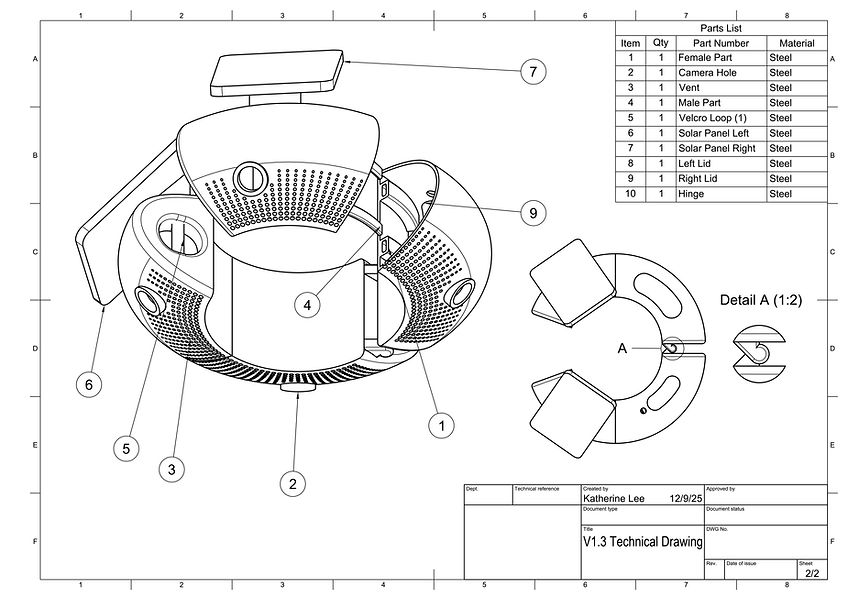
Mechanical design for the working prototype.

Beginning Prototype

The Device mounted on a street pole

Demo of the prototype detecting parking spots real time.
Pain Points
1. Handling the current prototype, tools, and cables while climbing and balancing is physically demanding and prone to dropped components.
2. The hands-on process for setup, alignment, and testing is tedious and complicated.
3. Exposed or poorly routed cables are vulnerable to damage, confusion, and shorting.
4. Achieving accurate camera positioning and coverage requires repeated adjustments to account for pole variations, sunlight glare, and optimal viewing angles.

Parametric and industrial forms were rejected due to manufacturing complexity and maintenance concerns.
Industrial
Minimalist 1
Minimalist 2
Parametric
Design Exploration
Final Sketch & Mechanical Design
< S

Rubber strip



.jpg)
CMF
Our current design (version 3) is torus-shaped with a matte, black finish.
Safety
A glossy finish could create specular reflections due to the sun, temporarily blinding drivers. A matte surface would diffuse sunlight.
Durability Reasons
Black plastics often use "Carbon Black" as a pigment, which is naturally excellent at absorbing UV radiation and preventing the plastic from becoming brittle, preventing photodegradation.
Adjustability
Due to its "torus-esque" shape, the device is easy to wrap around a cylindrical figure, being able to adjust to light poles of different sizes.
Sensor Accuracy
Matte black housing minimizes light scattering and internal reflections around the camera sensors, which allows the cameras to be accurate.
Contextual & Aesthetic Reasons
The dark value allows the form to blend seamlessly with municipal infrastructure, and reduce visual pollution in public spaces, while maintaining Spotwatch’s minimalist brand identity.
Prototype Assembly


Design Implications & Future Development Direction
As Spotwatch continues to make their minimal viable product, improvements will consistently be made on the prototype. After receiving feedback from engineers, on the right are target future developments I aim to make.
Cameras
The cameras should have the ability to be housed using the mounting screws. It should be able to run the cables cleanly throughout the chassis design.
Chassis
The entire chassis will be slimmed down so that it can be more portable but have necessary holes like the LoRa module radio antenna.
Solar Panels
Create a mounting bracket or finding a different solar panel that is robust enough to improve the design but also retain the necessary power to charge batteries.
Aesthetics
Create a color scheme Spotwatch will do all future work with. Form a distinguishable brand guideline.